With Opened Bible
This is a subtitle for your new post
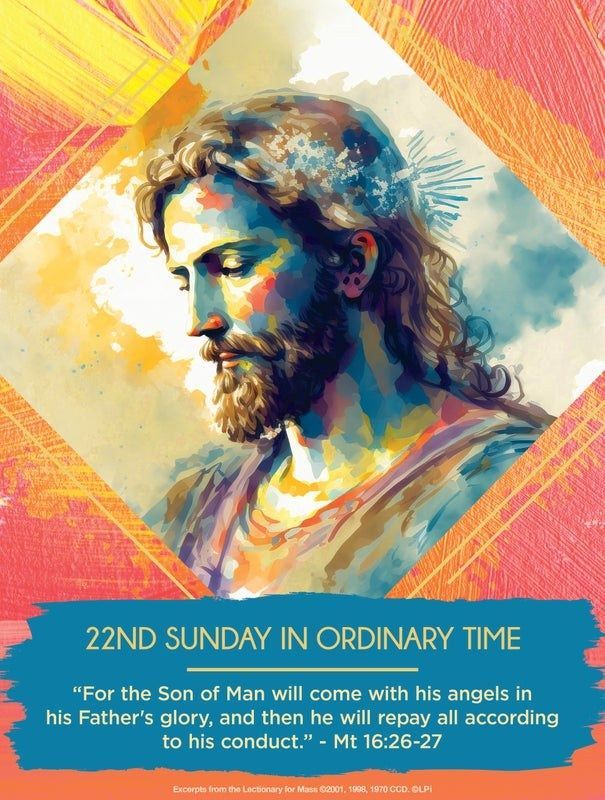
"Get behind me, Satan! You are an obstacle to me. You are thinking not as God does, but as human beings do." (Matthew 16, 23)
This Sunday's readings leave us perplexed about "how to understand God's plan for our lives?" In the first reading, Jeremiah (who is a type of Jesus in the Old Testament) tries to understand why he has so much faith, rejecting his duty but still doing what God expects of him. "I said to myself, 'I will not mention him, I will speak in his name no more.'
But then it became like a fire burning in my heart, imprisoned in my bones; I grew weary holding it in, I could not endure it." (Jeremiah 20:9) The voice of God cries out louder in the heart than the voice of fear.
In the Gospel, Peter, the faithful and enthusiastic apostle, did not under-stand that Jesus had come to "do the will of his Father." But the question we must ask ourselves is this: "What was God's will for Jesus?"
If we consider the Holy Scriptures, Jesus came into the world to save it through his sacrifice on Calvary: “Sacrifice and offering you did not desire, but a body you prepared for me; holocausts and sin offerings you did not delight in. Then I said, ‘As it is written of me in the scroll, Behold, I come to do your will, O God.’” (Hebrews 10:5-7) This divine will is to die for the love of the world he so loved. (Cf. John 3:16) And that is why, three times, Jesus foretold his passion, his death, and his resurrection” (Cf. Matthew 16:21-23; Mark 8:31-32; Luke 9:21-22).
This is something Peter, like Jeremiah, could not understand. Thus, he stood before God by rejecting His plan of salvation: “God forbid, Lord! No such thing shall ever happen to you.” In doing so, Peter played the role of Satan, whose thoughts, like those of every human being, are far from God’s. “For my thoughts are not your thoughts, nor are your ways my ways—oracle of the Lord. For as the heavens are higher than the earth, so are my ways higher than your ways, my thoughts higher than your thoughts.” (Isaiah 55:8-9)
The attitudes of Peter and Jeremiah are typical of human beings. But, beyond what we feel, we must never forget that God always does what He has decided: “As I have resolved, so shall it be; as I have planned, so shall it stand.” (Isaiah 14:24) And the best way to please him is to do his will like Jesus taught us: “not my will Father but yours be done.” ((Luke 22,42)